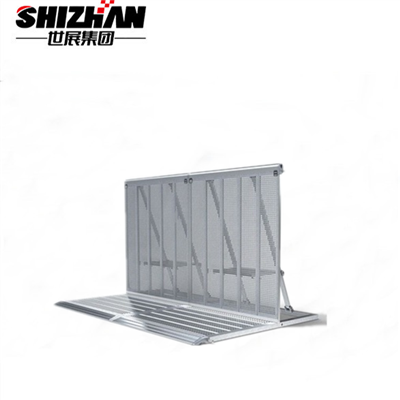
Q: What is a stage barrier?
A: Although known as 'stage' barriers, they can be used wherever crowd density is anticipated, eg licensed bars at outdoor events. The stage barrier is designed around a basic 'A' frame to be load-bearing, and is therefore normally used where there is a risk of crowd pressure.
Q: How tall is a stage barrier?
A: The barricade element has a length of 0.05 meters (2 inches), a depth of 0.20 meters (8 inches), and a height of about 1.18 meters (46 inches). It weighs 8,72 kilograms (19 pounds) and is easy to transport.
Q: How do stage barrier work?
A: Stage Barrier form a perfect arrangement of site demarcation. These barriers set boundaries within an event. Moreover, they can control a crowd of thousands of people because of their unified, interconnected weight effect.
Q: What are stage barrier used for?
A: Stage Barrier are used to control the flow of pedestrians at events, concerts, and public gatherings. They are typically made of steel or plastic and can be easily transported and set up. stage barrier are designed to prevent overcrowding and ensure the safety of attendees.
Q: What are Stage Barrier made of?
A: Robust and flexible stage barrier are essential for safe music festivals, concerts, sporting events, or other venues. stage barrier are made of robust and fire-resistant materials, primarily aluminum. So this makes them exceptionally stable.
Q: What are the dimensions of a stage barrier?
A: 2300 mm x 1100 mm in size.
Q: Why are there stage barrier at concerts?
A: Celebrating crowd could overrun everything and everyone on the festival grounds. These barriers protect the guests as well as all other event participants.
Q: What are the rules for stage barrier?
A: OSHA states that guardrail must reach a height of 42 inches, plus or minus 3 inches, above the walking-working surface and withstand a force of 200 pounds at any point in a downward or outward direction. If the railing dips below 39 inches, due to the force, the railing is not OSHA compliant.
Q: What must a stage barrier have at least?
A: Guardrail must have a toe board securely fastened to the posts and extending from the surface of the working area to a height of at least 125 mm when there is a risk of falling objects.
Q: What is the maximum gap between stage barriers?
A: A maximum opening of four inches between the two guardrails.
Q: Do all stage barrier must have a toe board?
A: No on low slope edges, Yes everywhere else.
Q: What must the top edge of a stage barrier be?
A: In general, specifies that the top edge of a guardrail system must be between 39 and 45 inches above the walking/working surface.
Q: Do stage barrier have to be continuous?
A: As for load requirements, stage barrier should be able to withstand a 200-pound concentrated load applied in an upward or downward direction. Other requirements include: The gripping surfaces should have minimal obstruction. They must be continuous.
Q: How do you erect a stage barrier?
A: You should erect barriers with escapes to the right and left of the stage, so that people can move away to safety. If a venue has restricted space, a straight barrier is suitable.
Q: How are stage barrier installed?
A: Layout guardrail in appropriate location
Mark centerline of post on floor
Using a 10” core bit or larger; core 12” deep or greater
Using a forklift or two person team, align guardrail above cored holes
Cement guardrail legs into place
Your guardrail is now installed
Q: When should stage barrier be fitted?
A: You must fit guardrails to the platform if your risk assessment has shown that there is a danger of a fall liable to cause personal injury. That risk may exist even at low platform heights.
Q: Where should stage barrier be installed?
A: Areas with high personnel traffic. Any location within a facility where people are most likely to be or congregate is an optimal place to install a guardrail.
Q: Can chains be used as stage barrier?
A: If used, chains must be equivalent to a guardrail, so at least two chains would be needed because a guardrail must have a top rail and mid rail.
Q: Are gigs stage barricades safe?
A: Robust and flexible Stage Barricades are essential for safe music festivals,concerts, sporting events, or other venues.
Q: What are the stage barrier parts called?
A: To simplify, a guardrail consists of two key functional components: the end terminal and the guardrail face.